
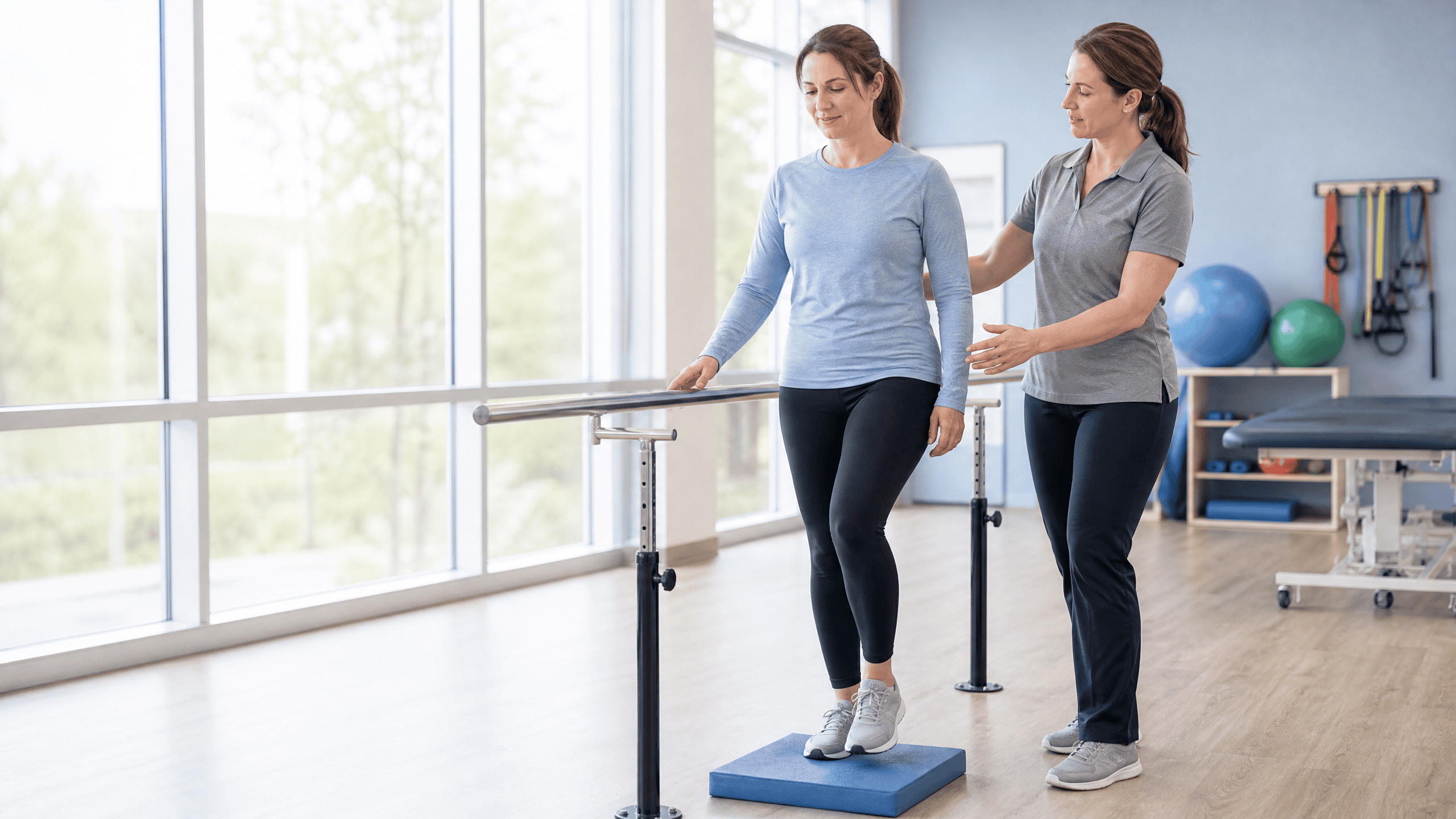
Multiple sclerosis physical therapy in Georgia can help people living with MS work toward better balance, strength, walking ability, endurance, and confidence in daily life. Because MS affects every person differently, rehabilitation should never be a one-size-fits-all exercise routine. At Onesource Sports Neuro Rehab, physical therapy is built around each patient’s symptoms, mobility level, priorities, and medical plan, with convenient care for communities including Lawrenceville, Tucker, Snellville, Newnan, Loganville, and Atlanta.
What Is Multiple Sclerosis Physical Therapy?
Multiple sclerosis is an immune-mediated condition that affects the brain and spinal cord. Damage to myelin—the protective covering that helps nerve signals travel efficiently—can interfere with movement, sensation, vision, coordination, and thinking. Symptoms may include fatigue, weakness, muscle stiffness, reduced balance, changes in walking, dizziness, pain, or difficulty completing everyday activities. Symptoms can also change over time, which is why rehabilitation goals may need to change as well.
Physical therapy does not cure MS or replace care from a neurologist. Instead, it complements medical treatment by addressing the movement and functional challenges that can make work, family responsibilities, recreation, and self-care more difficult. The National Multiple Sclerosis Society describes MS rehabilitation as a dynamic process in which the frequency, intensity, and setting of treatment are based on the individual’s changing needs.4
What Does the Evidence Say About Exercise and Rehabilitation?
Research supports appropriately prescribed exercise as an important part of MS rehabilitation. A 2025 systematic review and meta-analysis evaluated 20 studies with 577 participants. Combined programs using more than one type of exercise produced significant improvements in lower-extremity strength, balance, walking speed, walking endurance, and quality of life, while also reducing fatigue. The reported effect was especially notable for balance, with a standardized mean difference of 1.20 (95% confidence interval 0.76–1.64; p=0.001).1
Fatigue is one of the most common and frustrating MS symptoms, but activity does not automatically make fatigue worse. A meta-analysis of 31 studies, including 714 participants in exercise groups and 720 controls, concluded that regular physical exercise significantly reduced MS-related fatigue.2 The key is finding the right dose. A physical therapist can help patients alternate activity and recovery, monitor exertion, and gradually build capacity rather than pushing through symptoms.
An American Academy of Neurology systematic review also found that weekly home or outpatient physical therapy over eight weeks was probably effective for improving balance, disability, and gait in ambulatory people with MS. Short programs of motor and sensory balance training were possibly effective for improving static and dynamic balance.3 These findings are encouraging, but they do not guarantee the same result for every person. Progress depends on MS type, current symptoms, other health conditions, consistency, and the goals selected with the rehabilitation team.
Who Can Benefit From MS Rehabilitation?
Physical therapy may be helpful soon after diagnosis, after a relapse, when mobility changes, or as part of long-term wellness. Patients commonly seek help for unsteadiness, falls or fear of falling, leg weakness, stiffness, reduced walking distance, difficulty using stairs, poor coordination, or fatigue that limits daily tasks. Therapy can also help determine whether a cane, brace, walker, or other device could improve safety and conserve energy.
Some people with MS experience a temporary increase in symptoms when they become overheated or overexerted. This does not necessarily mean that new neurologic damage has occurred, but it is still important to respond carefully. Sessions may use shorter activity intervals, cooling strategies, hydration, rest breaks, and symptom monitoring. New, severe, or persistent neurologic symptoms should be reported promptly to the patient’s medical team.
Common Parts of an Individualized MS Physical Therapy Plan
| Rehabilitation Component | What It May Address | How It Is Personalized |
|---|---|---|
| Strength training | Leg or trunk weakness, transfers, stairs, and daily tasks | Resistance, repetitions, position, and rest are adjusted to ability |
| Balance and coordination | Unsteadiness, fall risk, turning, and uneven surfaces | Tasks progress from supported practice to real-life challenges |
| Walking and endurance | Gait efficiency, reduced stamina, and community mobility | Speed, distance, assistive devices, and recovery intervals are monitored |
| Flexibility and mobility | Stiffness, limited range of motion, and movement comfort | Positions and duration are selected to avoid unnecessary fatigue |
| Energy management | Fatigue during work, home tasks, exercise, or recreation | Pacing, task planning, cooling, and rest strategies match daily routines |
What to Expect at Onesource Sports Neuro Rehab
Your first visit begins with a detailed evaluation. A physical therapist may assess walking, balance, posture, strength, flexibility, coordination, endurance, fall history, assistive-device use, and the activities that matter most to you. Together, you will establish practical goals such as walking farther, getting up from a chair more easily, returning to a favorite activity, or moving more safely at home.
Treatment may combine aerobic activity, progressive strengthening, balance practice, gait training, flexibility work, neuromuscular re-education, education, and a home program. A 2025 review of clinical practice guidelines supports structured aerobic and resistance training along with balance and flexibility exercises, while emphasizing that plans must be individualized.5 Although some guidance describes a gradual goal of up to 150 minutes of weekly activity, that figure is not a required starting point. Your safe starting level may be much lower, and progress should reflect symptoms, capacity, and medical considerations.
Regular reassessment is essential. If fatigue, balance, walking, or life circumstances change, the plan can be revised. With your permission, the physical therapist can also coordinate with your neurologist and other members of your care team so that rehabilitation supports—not competes with—your broader MS treatment.
Find Multiple Sclerosis Physical Therapy in Lawrenceville, Tucker, and Beyond
People living with MS deserve rehabilitation that respects both the complexity of the condition and the realities of everyday life. Onesource serves patients across Lawrenceville, Tucker, Snellville, Newnan, Loganville, and Atlanta with patient-centered neurological rehabilitation focused on meaningful function. If changes in balance, strength, walking, or fatigue are limiting your independence, contact Onesource Sports Neuro Rehab today to schedule a physical therapy evaluation and discuss a plan designed around your goals.
References
- Pakdel, F. K., Pakdel, A. K., Zarei, H., et al. (2026). Combined training improves functional capacity, fatigue, and quality of life in individuals with multiple sclerosis: a systematic review and meta-analysis. BMC Neurology, 26, 17. https://doi.org/10.1186/s12883-025-04548-z
- Razazian, N., Kazeminia, M., Moayedi, H., et al. (2020). The impact of physical exercise on the fatigue symptoms in patients with multiple sclerosis: a systematic review and meta-analysis. BMC Neurology, 20, 93. https://doi.org/10.1186/s12883-020-01654-y
- Haselkorn, J. K., Hughes, C., Rae-Grant, A., et al. (2015). Summary of comprehensive systematic review: Rehabilitation in multiple sclerosis. Neurology, 85(21), 1896–1903. https://doi.org/10.1212/WNL.0000000000002146
- National Multiple Sclerosis Society. The MS Rehabilitation Process. View resource.
- Alhusayni, A. I. (2025). A narrative review of clinical practice guidelines for the application of physical therapy and rehabilitation procedures in the management of multiple sclerosis. Neurosciences (Riyadh), 30(4), 262–270. https://doi.org/10.17712/nsj.2025.4.20250054