
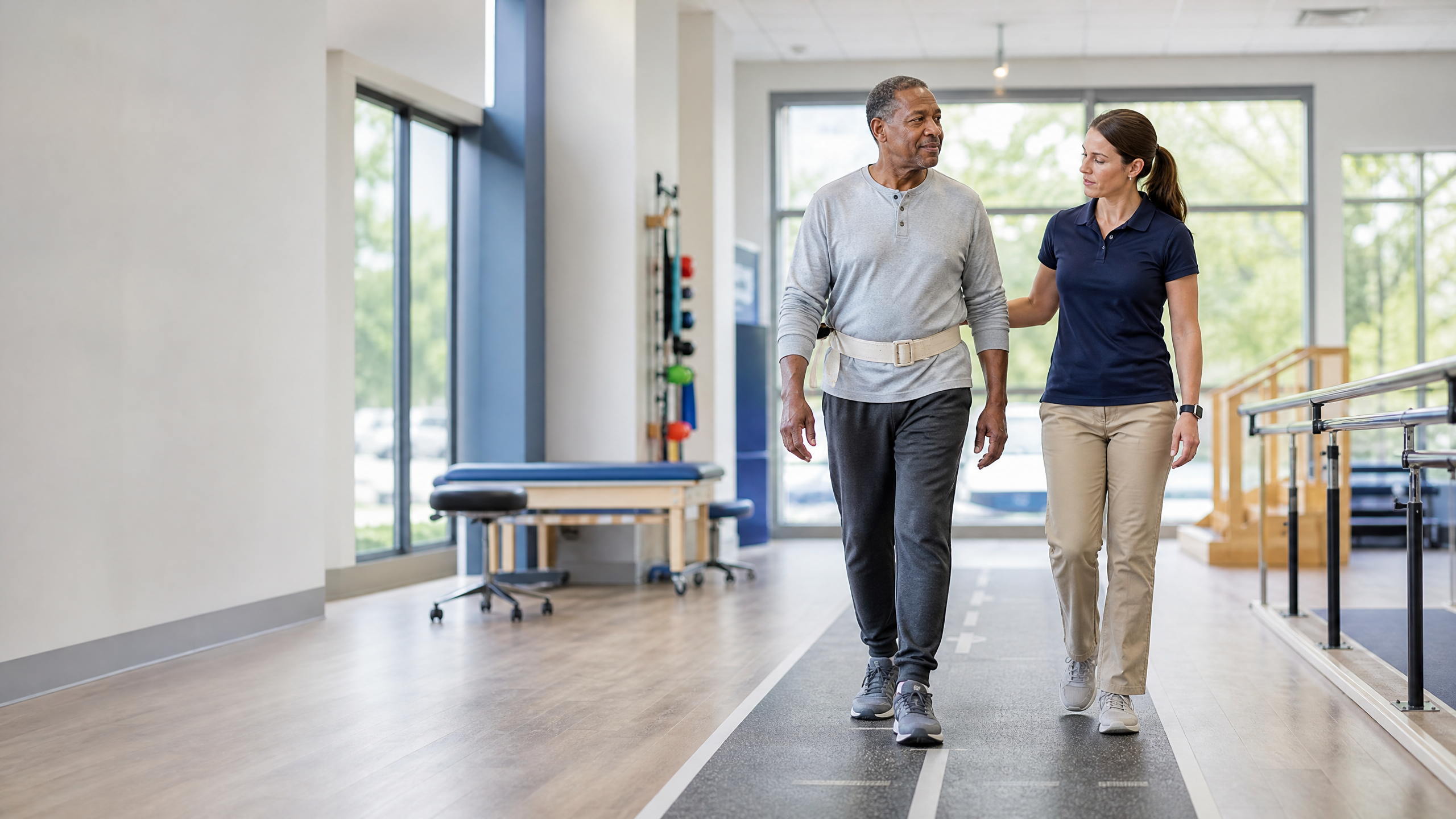
Stroke gait training in Lawrenceville, GA can help people rebuild practical walking skills after a stroke, one meaningful movement at a time. Changes in strength, sensation, coordination, vision, balance, or confidence can make a familiar trip across a room feel uncertain. The goal of rehabilitation is not simply to do more exercise; it is to practice the movements that matter in daily life in a safe, progressive way. At Onesource Sports Neuro Rehab, an individualized plan may focus on the abilities you want to regain, such as getting up from a chair, moving through your home, managing a curb, or walking more confidently in the community.
Every stroke and recovery path is different. A qualified rehabilitation evaluation helps identify what is affecting your walking and what level of support, assistive device, and supervision may be appropriate. New or suddenly worsening weakness, speech difficulty, facial drooping, severe headache, chest pain, unusual shortness of breath, or a fall with injury requires urgent medical attention rather than a new exercise program.
What Is Task-Specific Gait Training?
Task-specific gait training is a rehabilitation approach built around repeated, purposeful practice. Instead of treating walking as a single skill, your therapist breaks it into the movements and situations you need to navigate safely. Practice may include sit-to-stand transfers, starting and stopping, shifting weight, stepping forward or sideways, changing direction, walking around an obstacle, stepping over a low object, or climbing a step. The tasks are selected and adjusted for your current abilities and goals.
This approach is grounded in motor learning: the nervous system benefits from practicing relevant actions. In the clinic, a therapist can watch how you move, identify barriers such as reduced foot clearance or uneven weight shift, and modify the task. Depending on your needs, a session may also include balance work, strengthening, endurance practice, education, or caregiver guidance. A walker, cane, brace, gait belt, or hands-on assistance may be used when clinically appropriate.
What Does the Clinical Evidence Show?
Research supports purposeful, repeated mobility practice as one component of post-stroke rehabilitation. A 2025 systematic review and meta-analysis of 17 randomized controlled trials involving 888 participants found that task-oriented training improved gait speed, gait endurance, balance, and Timed Up and Go performance compared with control interventions.1 These are meaningful measures because they relate to the everyday demands of standing, turning, and walking.
A Cochrane review of 33 trials with 1,853 participants found moderate-quality evidence that repetitive task training improved walking distance by an average of 34.8 meters and improved functional ambulation after stroke.2 A smaller randomized trial of task-specific circuit gait training reported significant improvements after six weeks in timed mobility, cadence, step length, and step width.3
These findings do not guarantee the same result for every person. The research also reflects differences in stroke severity, time since stroke, therapy setting, and practice dose. The most useful plan is one that is individualized, safely progressed, and measured over time rather than copied from a generic routine.
Who May Benefit From Stroke Gait Rehabilitation?
Gait training may be considered for people who notice slower or less steady walking, trouble clearing a foot, difficulty turning, fatigue with short distances, or fear of falling after a stroke. It can be relevant during earlier recovery and for people who are months or years beyond their stroke and want to address a specific mobility goal. Your plan should reflect your medical history, current symptoms, medications, home setup, caregiver support, and the tasks that are most important to you.
Safety comes first. Some people need one-on-one guarding, an assistive device, a clear walking path, or a caregiver nearby for parts of practice. Others may require additional medical assessment before exertion is increased. A rehabilitation professional can explain what is appropriate for you and when in-clinic treatment, home health, or coordination with your physician is the better option.
What to Expect at Onesource
At Onesource, a stroke gait evaluation begins with listening to your goals and learning about the obstacles you face at home and in the community. Your therapist may assess transfers, standing tolerance, walking pattern, balance, endurance, and the way you manage turns or changes in surface. The assessment is not a pass-or-fail test; it establishes a starting point and helps guide a realistic treatment plan.
Your sessions may then combine structured practice with education. For example, a person whose goal is to move safely from a living-room chair to the kitchen may practice standing, initiating steps, turning, and stopping with the right level of support. A person working toward community mobility may practice variable walking tasks and endurance within a clinically appropriate progression. Therapists reassess progress and adjust the plan as your abilities and goals change.
How Task-Specific Practice Fits Into a Recovery Plan
| Rehabilitation focus | Examples of practice | Why it may be included |
|---|---|---|
| Task-specific gait training | Transfers, walking starts and stops, turns, obstacle negotiation, steps | Builds practice around real mobility goals |
| Balance and weight shifting | Controlled reaching, stepping, supported standing challenges | Addresses stability needed for safe movement |
| Strength and endurance work | Individualized lower-extremity and conditioning activities | Supports tolerance for repeated daily movement |
| Education and home safety | Assistive-device instruction, fall-risk awareness, caregiver coaching | Helps carry safe strategies into daily routines |
The right mix changes from person to person. A therapist may begin with simpler, supported tasks and gradually introduce more complex practice as control, confidence, and safety allow. The purpose is to make practice relevant—not to push through symptoms or attempt unsupervised challenges beyond your ability.
Stroke Gait Training in Lawrenceville, Tucker, and Beyond
When travel, mobility changes, or a new neurologic diagnosis make daily life feel smaller, you do not have to navigate the next steps alone. Onesource Sports Neuro Rehab provides patient-centered rehabilitation for individuals and families across Lawrenceville, Tucker, Snellville, Newnan, Loganville, and Atlanta. Whether your goal is to move more safely at home, return to valued activities, or understand what support may help after a stroke, an evaluation can provide a thoughtful starting point. Contact Onesource Sports Neuro Rehab today to book an evaluation and discuss a rehabilitation plan tailored to your mobility goals.
References
- Lee MH, Lee DY. (2025). Effects of Task-Oriented Training on Gait Outcomes and Balance in Individuals with Stroke: A Systematic Review and Meta-Analysis of Randomized Controlled Trials. Journal of Clinical Medicine, 14(24), 8766. https://doi.org/10.3390/jcm14248766
- French B, Thomas LH, Coupe J, et al. (2016). Repetitive task training for improving functional ability after stroke. Cochrane Database of Systematic Reviews, 11, CD006073. https://doi.org/10.1002/14651858.CD006073.pub3
- Qurat-Ul-Ain, Malik AN, Haq U, Ali S. (2018). Effect of task specific circuit training on gait parameters and mobility in stroke survivors. Pakistan Journal of Medical Sciences, 34(5), 1300–1303. https://doi.org/10.12669/pjms.345.15006