
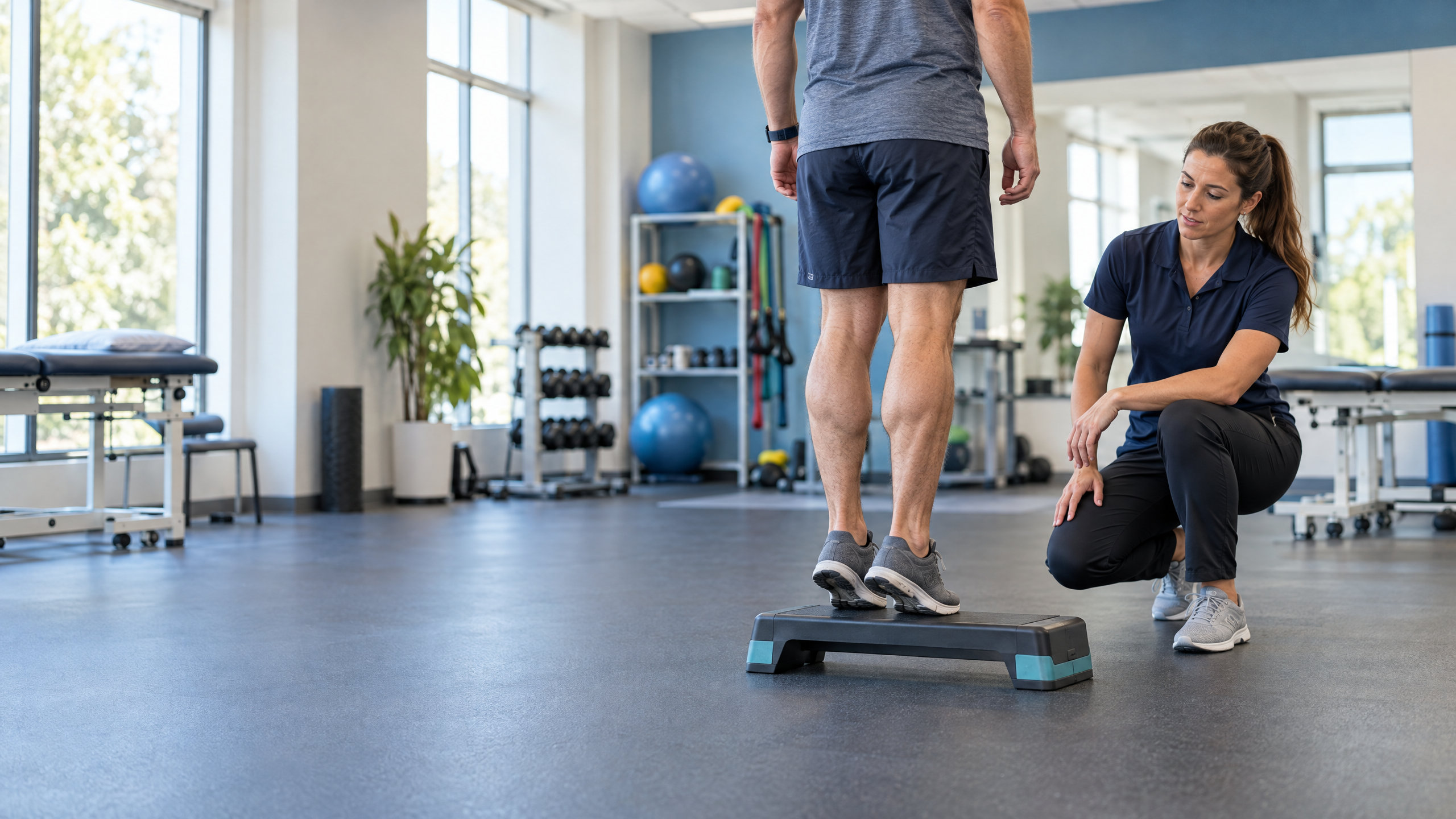
If pain or stiffness at the back of your heel is changing the way you walk, climb stairs, run, or play with your family, Achilles tendinopathy treatment in Lawrenceville, GA may help you move forward with a plan that fits your body and goals. The Achilles tendon connects your calf muscles to your heel. When it becomes irritated and less able to tolerate load, the answer is rarely to simply “push through” or stop moving forever. A thoughtful physical therapy plan can help you manage symptoms, rebuild capacity, and return to activity gradually.
At Onesource Sports Neuro Rehab, we begin with an individual evaluation. Your work demands, activity level, footwear, recent changes in training or walking, strength, and goals all matter. This guide explains what Achilles tendinopathy is, what current rehabilitation research supports, and when heel pain needs prompt medical attention.
What Is Achilles Tendinopathy?
Achilles tendinopathy is a term for pain and reduced function involving the tendon at the back of the ankle. It often develops after a change in load: a new running routine, more hills or stairs, a return to court sports, a jump in work-related walking, or even a period of reduced conditioning followed by doing too much too soon. Symptoms may include tenderness along the tendon, stiffness with the first steps in the morning, pain during heel raises or push-off, and discomfort that returns after activity.
Not every sore heel is Achilles tendinopathy. Pain very close to the heel bone can behave differently from pain in the middle portion of the tendon. A physical therapist can help identify the pattern and consider other contributors, such as calf weakness, ankle mobility, balance, or an abrupt change in activity. A sudden pop, sharp pain, marked swelling, inability to push off, or difficulty bearing weight should be assessed promptly because those symptoms can signal a more serious injury.
Why Progressive Loading Is Central to Recovery
It is understandable to protect a painful tendon. Short-term changes in aggravating activity can be useful, especially during a flare. But complete rest for long periods can leave the calf-and-tendon system less prepared for everyday demands. Current physical therapy guidance identifies tendon-loading exercise as a first-line approach for midportion Achilles tendinopathy because it can improve pain and function when the load is matched to the person.1
“Loading” does not mean forcing through sharp pain. It means using a planned progression that may begin with comfortable calf activation and controlled heel raises, then build toward heavier resistance, single-leg work, walking tolerance, stairs, running, or sport-specific movements. The right starting point and pace are different for a recreational runner, a warehouse employee, a busy parent, and a person returning after a long period of inactivity.
What Does the Research Say?
The strongest message from the research is not that there is one magic exercise. A 2023 systematic review and meta-analysis included 12 randomized trials and 543 participants with midportion Achilles tendinopathy. It found no single loading protocol consistently superior for pain and function, reinforcing the value of selecting an approach that a patient can perform correctly and follow over time.2
A randomized trial of 58 people compared a traditional eccentric program with a heavy-slow-resistance program for 12 weeks. Both groups had significant improvements in pain and Achilles function that were maintained at one year (P < .0001). Adherence was higher in the heavy-slow-resistance group—92% versus 78%—showing why a program should be realistic for the patient’s routine, not simply copied from someone else’s plan.3
These findings do not mean every exercise is interchangeable or that pain should be ignored. They support a guided, progressively loaded plan. A clinician can adapt the exercise type, range, resistance, and recovery days based on your symptoms and goals.
What to Expect at Onesource
Your first visit at Onesource starts with listening: when did the pain begin, what has changed, and what do you need to get back to? We then assess walking, calf strength, heel-raise tolerance, ankle movement, balance, and the activities that currently provoke symptoms. When appropriate, your plan may include education on activity modification, a progressive calf-and-tendon strengthening program, movement retraining, and a staged return to higher-demand activity.
We also look beyond the sore spot. For some patients, training progression, recovery habits, work demands, footwear, or lower-extremity mechanics may be part of the picture. Supportive measures can help symptoms settle, but they work best when they support—not replace—the active rehabilitation plan. Mayo Clinic similarly notes that short-term measures such as activity modification, ice, compression, and elevation may help manage symptoms while a care plan is underway.4
From Flare Management to Return to Activity
| Rehabilitation focus | What it may include | Why it matters |
|---|---|---|
| Settle the flare | Temporary changes to painful activities and comfortable movement | Helps reduce unnecessary aggravation without abandoning all activity |
| Build tendon capacity | Progressive calf-and-tendon loading selected for your tolerance | Prepares the tendon for walking, stairs, work, and exercise demands |
| Return to higher-demand activity | A gradual plan for hills, jogging, jumping, or sport-specific tasks | Builds confidence while monitoring the tendon’s response |
Progress is usually measured by more than a pain score. We want to see improved walking, stronger and more comfortable heel raises, better tolerance for work or recreation, and a sensible response after activity. Recovery is not linear; a temporary increase in symptoms can be information to adjust a plan rather than proof that all movement is harmful.
Find Achilles Tendinopathy Treatment in Lawrenceville, Snellville, and Beyond
Whether you are dealing with heel pain in Lawrenceville, returning to your routine in Snellville, or looking for orthopedic rehabilitation near Tucker, Newnan, Loganville, or Atlanta, Onesource Sports Neuro Rehab can help you take the next step with confidence. Contact Onesource Sports Neuro Rehab today to book an evaluation and receive a personalized plan for Achilles tendon pain, recovery, and return to the activities that matter to you.
References
- Chimenti RL, et al. (2024). Achilles Pain, Stiffness, and Muscle Power Deficits: Midportion Achilles Tendinopathy Revision 2024. Journal of Orthopaedic & Sports Physical Therapy. https://doi.org/10.2519/jospt.2024.0302
- Maetz R, Dubé M-O, Tougas A, et al. (2023). Systematic review and meta-analyses of randomized controlled trials comparing exercise loading protocols with passive treatment modalities or other loading protocols for the management of midportion Achilles tendinopathy. Orthopaedic Journal of Sports Medicine. https://doi.org/10.1177/23259671231171178
- Beyer R, Kongsgaard M, Hougs Kjær B, et al. (2015). Heavy slow resistance versus eccentric training as treatment for Achilles tendinopathy: A randomized controlled trial. American Journal of Sports Medicine. https://doi.org/10.1177/0363546515584760
- Mayo Clinic Staff. (2025). Achilles tendinitis: Diagnosis and treatment. Mayo Clinic