
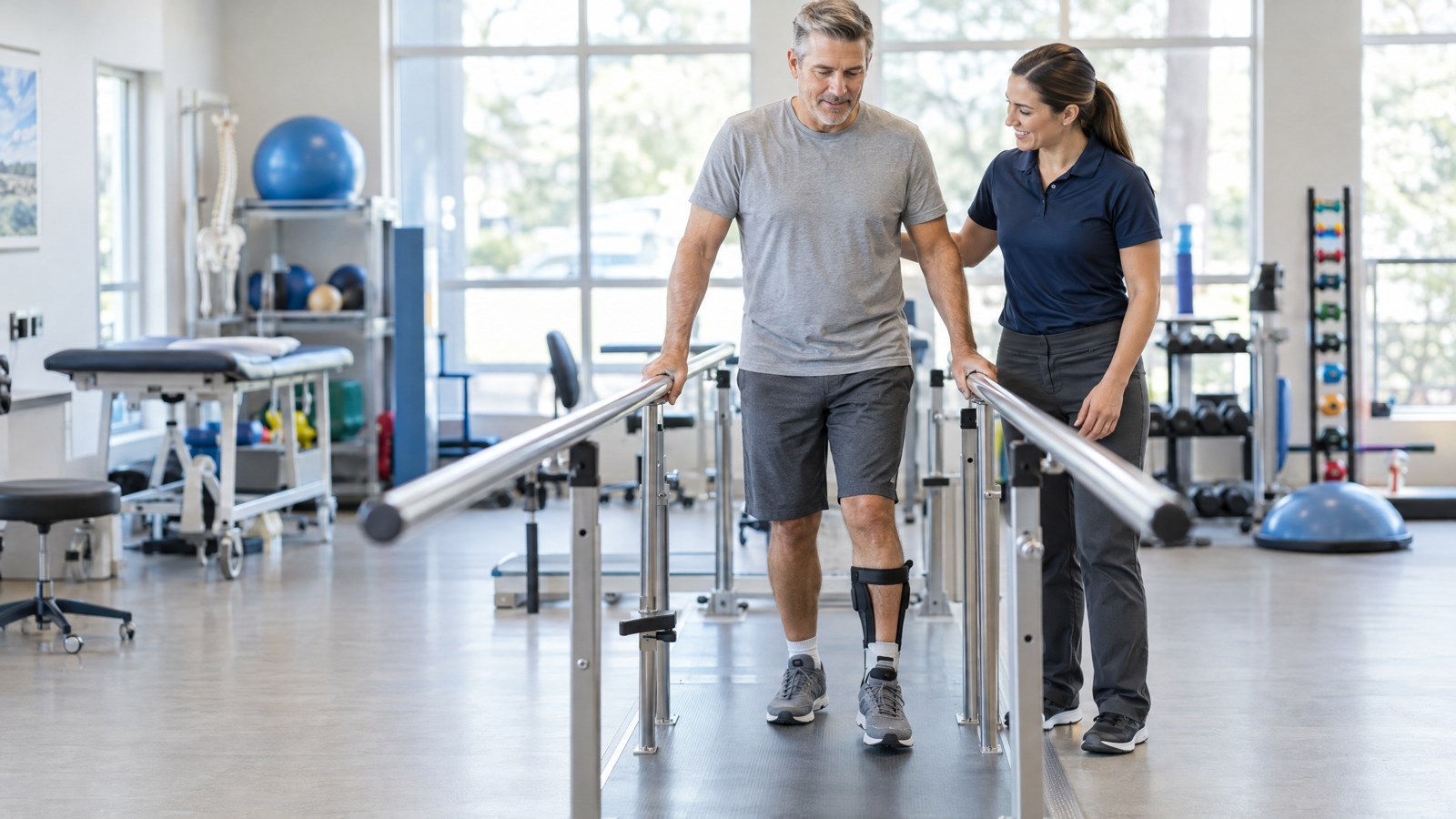
Foot drop rehabilitation in Lawrenceville, GA can help you work toward safer walking when lifting the front of your foot becomes difficult. Catching your toes on a rug or feeling your foot slap the floor can make everyday outings stressful. The first step is finding the cause—not simply trying harder to walk normally.
At Onesource Sports Neuro Rehab, a personalized evaluation can help identify your movement needs and guide a rehabilitation plan alongside medical care. This guide explains foot drop, the evidence behind walking supports, and practical questions to bring to your appointment.
What Is Foot Drop, and Why Does It Happen?
Foot drop is a symptom, not a diagnosis. Weakness in the muscles that lift the foot can cause your toes to drag. You may compensate by raising your knee unusually high or swinging your leg outward. One or both feet can be affected, sometimes with numbness.1
Possible causes include compression or injury of the peroneal nerve near the knee, a spinal nerve-root problem, or conditions affecting the brain or spinal cord, such as stroke or multiple sclerosis. These problems are not interchangeable: the cause influences treatment and the chance of recovery.1
A clinician may examine your walking, strength, and sensation. Imaging or nerve tests may be needed. New difficulty lifting your foot deserves medical assessment even if it is painless.2
When Weakness Needs Emergency Care
Call 911 for sudden new foot or leg weakness, especially on one side. Facial drooping, speech changes, arm weakness, or sudden vision or balance problems make stroke particularly concerning, but do not wait for every symptom to appear. Note when symptoms started and do not drive yourself.6
Back or leg symptoms with new loss of bladder or bowel control, difficulty urinating, or numbness between the legs also require immediate emergency evaluation. These can signal serious compression of spinal nerves. Do not wait for a routine therapy visit.7
How Physical Therapy Can Support Walking
Once the underlying problem has been evaluated, physical therapy may address appropriate leg strengthening, ankle and knee mobility, and calf flexibility. Walking practice can focus on clearing the toes and placing the foot more consistently. Your program should reflect your remaining muscle control, sensation, fatigue, and goals—not a generic online exercise list.2
An ankle-foot orthosis (AFO) is a brace that supports the ankle and foot during walking. It may help when weakness makes toe clearance difficult. A clinician should assess fit and function, rather than choosing a brace only from a photograph or product review.2
Functional electrical stimulation (FES) uses timed electrical pulses to help activate muscles that lift the foot. It is an option for selected neurological cases, not everyone. Walking-related FES is not normally suitable when the problem involves a lower-motor-neuron lesion, such as certain peripheral nerve injuries. Discuss eligibility and availability with your rehabilitation team.5
What Does the Research Show?
A randomized trial enrolled 495 adults at least six months after stroke. Over six months, average walking speed increased by 0.186 meters per second with FES and 0.195 with an AFO, without a significant difference between groups. Initial testing was without the study device and final testing was with it, so these results do not prove permanent recovery without support.3
A meta-analysis of five trials involving 815 stroke participants found broadly comparable walking benefits. At final assessment, the pooled walking-speed difference was only 0.01 meters per second, with uncertainty spanning an advantage for either device. The review included the trial above, so these are overlapping—not separate—patient groups.4
A 2021 clinical guideline also supports AFO and FES for improving post-stroke walking speed and mobility, without an overall winner. These findings concern stroke; they should not be assumed to apply to every cause of foot drop. Neither device guarantees that weakness will disappear.8
Comparing Common Rehabilitation Supports
| Support | Main role | Important consideration |
|---|---|---|
| Individualized physical therapy | Practice movement, preserve mobility, and address suitable strength goals. | Exercise selection depends on the cause and muscle control. |
| Ankle-foot orthosis | Support foot position and toe clearance during walking. | Fit, footwear, comfort, and skin checks matter. |
| Functional electrical stimulation | Assist active foot lifting in selected neurological cases. | Requires candidacy assessment; not appropriate for every nerve injury. |
What to Expect at Onesource
Bring your medical history, current brace or walking aid, and usual shoes. Tell your therapist when toe dragging happens, whether you have fallen, and which activities feel difficult. Meaningful goals might include reaching the mailbox, navigating a curb, or walking through a grocery store.
Your evaluation can guide supervised practice, home exercises, and coordination with your referring clinician or a brace specialist. Ask how progress will be measured and when equipment needs reassessment. Recovery varies: safer, more efficient movement can be worthwhile even when a brace remains necessary.
At home, clear cords and clutter from walking routes, remove loose throw rugs, and improve lighting. These precautions support safety while you work on mobility.2
References
- Mayo Clinic. Foot drop: Symptoms and causes.
- Mayo Clinic. Foot drop: Diagnosis and treatment.
- Bethoux F, et al. (2014). Peroneal nerve FES versus AFO in chronic stroke: randomized trial. Neurorehabilitation and Neural Repair, 28:688–697. doi:10.1177/1545968314521007.
- Prenton S, Hollands KL, Kenney LPJ. (2016). FES versus AFO for foot drop: meta-analysis of orthotic effects. Journal of Rehabilitation Medicine, 48:646–656. doi:10.2340/16501977-2136.
- NICE. Functional electrical stimulation for drop foot of central neurological origin.
- CDC. Signs and symptoms of stroke.
- AAOS OrthoInfo. Cauda equina syndrome.
- Johnston TE, et al. (2021). Clinical practice guideline for AFO and FES post-stroke. Journal of Neurologic Physical Therapy, 45:112–196. doi:10.1097/NPT.0000000000000347.
Find Support in Lawrenceville, Tucker, and Beyond
Looking for foot drop rehabilitation in Lawrenceville or Tucker? Onesource Sports Neuro Rehab welcomes questions from patients in Snellville, Newnan, Loganville, and Atlanta, too. Contact the clinic to discuss your needs, appointment options, and whether a medical referral is appropriate. This article is educational and does not replace diagnosis or individualized care.
Contact Onesource Sports Neuro Rehab and book an evaluation to take the next step toward safer everyday movement.